
Foundation of
liberty
The Historical Site Where the Rule of Law Began
In June 1215, King John sealed Magna Carta and this was to change the course of English History.
It was an agreement meant to bring to an end a bitter civil war which had broken out earlier in that year.
On one side was a group of barons, mainly from northern England and East Anglia, rebelling against what they saw as tyrannical royal rule. On the other, was a ruthless and autocratic monarch, King John.
After gaining the upper hand by capturing London, the barons forced King John to negotiate. On 15 June the two sides made an agreement known to history as Magna Carta, the Great Charter, what Lord Judge called “the most important single document in the development of constitutional and legal freedom”.
"No freeman shall be taken, imprisoned, disseised, outlawed, banished, or in any way destroyed, nor will We proceed against or prosecute him, except by the lawful judgment of his peers or by the law of the land." "To no one will We sell, to no one will We deny or delay, right or justice."
MAGNA CARTA 1215
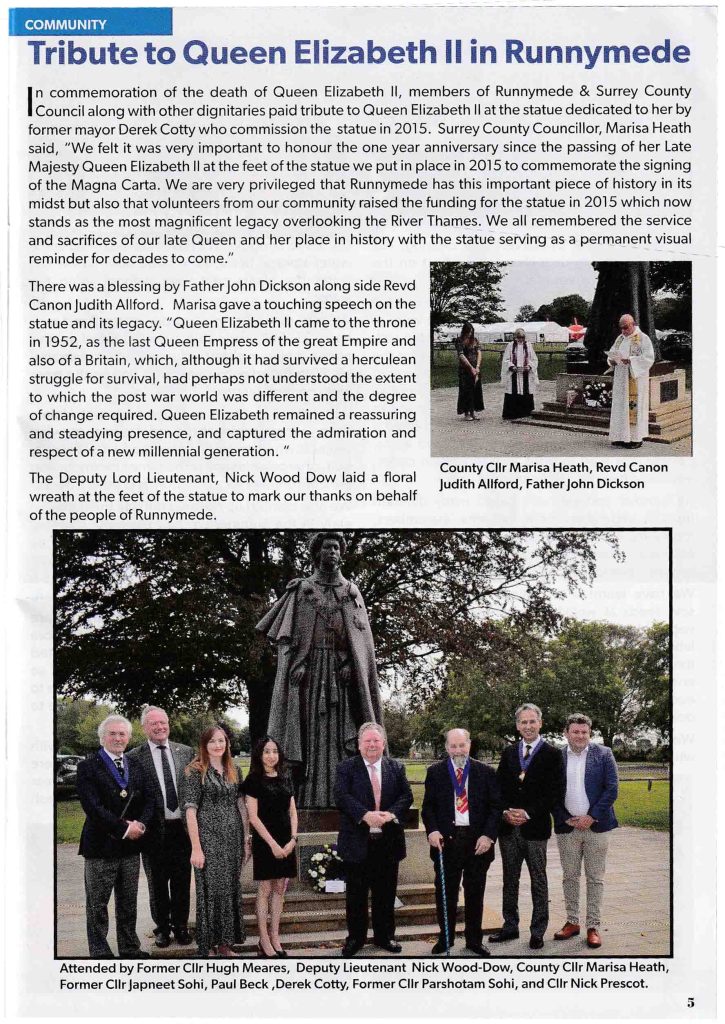
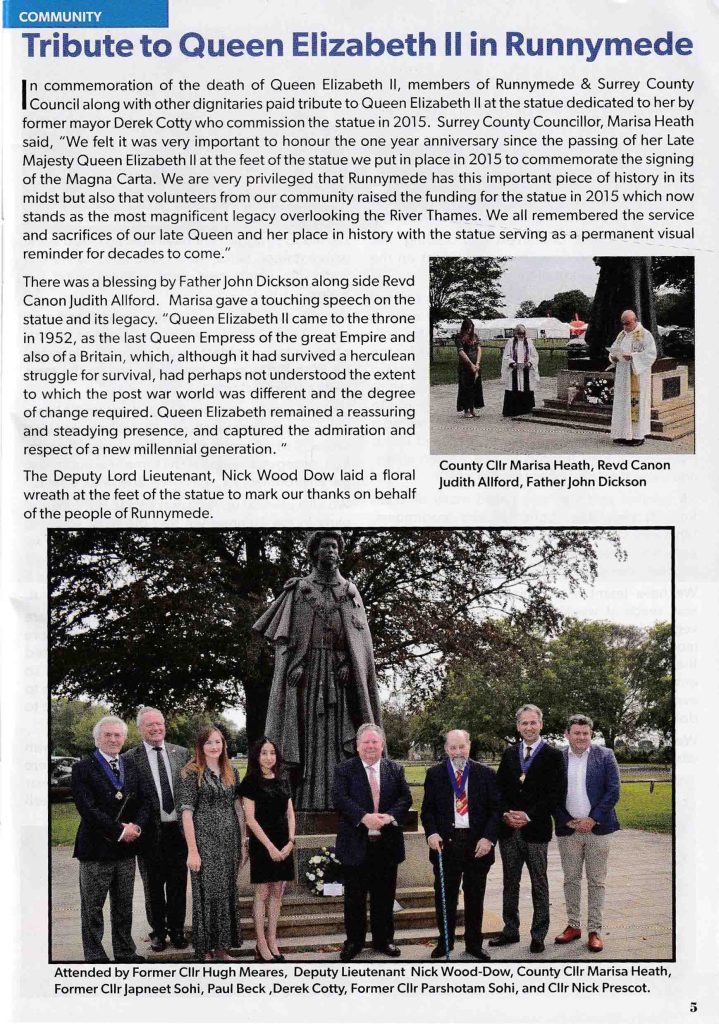
Queen Elizabeth II Statue
To mark the 800th anniversary of the sealing of Magna Carta in the meadows of Runnymede, a new memorial was raised on the banks of the Thames at Runnymede.
The 4M (13ft) statue was inspired by the famous 1954 and 1969 portraits of Her Majesty Queen Elizabeth II by Pietro Annigoni.
The Queen is shown in full Garter Robes. The statue is cast in bronze and reflects more than 1,000 years of uninterrupted English monarchy.
The sculptor, James Butler, MBE, RA is one of Britain’s foremost figurative sculptors. His work adorn many sites in London and other cities around the world.
The statue was conceived and erected by the Trustees of Runnymede Magna Carta Legacy, a charity reported to have raised more than £500,000.
The TimeLine traces the 800 year progression from the tyrannical King John to the present constitutional monarch Queen Elizabeth II, recording in stone the monarchs and rulers of England and Scotland. The longer the reign of the Monarch the more stone is allotted to them.
Contrast the shortest reign of “Lady Jane Gray the nine day queen” with the reign of Queen Elizabeth II the longest reigning Monarch in British history.
CELEBRATING MAGNA CARTA
The Queen's Barge at Runnymede
THE TIMELINE
FIND OUR LOCAL QR CODES

Coronation oath of Henry I, 1100, affirmed the principles going back to the laws of King Ethelbert of Kent, circa 604, and subsequent laws of the Kings of Kent leading up to the end of the Millenium.
Magna Carta is so much more than a peace treaty between a quarrelsome King and his barons, sealed (not signed) in a meadow on the banks of the Thames on 15th June 1215. Its lasting iconic value as the foundation of so many world democracies lies in the power of an idea – a principle, which states that nobody, including the King, is above the law of the land.
Toggle Content
Simon de Montfort, Anglo-Norman rebel noblemen, convened a ‘parliament’ in Westminster on 20th January 1265, which was dispersed around mid March that year. It was not only in defiance of King Henry III, but was radical in having democratically elected knights and borough representatives from throughout the kingdom. The de Montfort Parliament was the first example of its kind in England.
The Habeas Corpus Act of 1679, was passed during the reign of the restored monarchy of Charles II after the English Civil War. It strengthened the ancient and powerful writ which had been a feature of English Common Law since before Magna Carta. It served to safeguard individual liberty, preventing unlawful or arbitrary imprisonment. Habeas Corpus is Latin for “you may have the body” – subject to legal examination before a court, or a judge.
The American Declaration of Independence as penned by Thomas Jefferson was instead an indictment of George III’s numerous breaches of English Common Law enshrined within Magna Carta, to which the thirteen colonies were equally bound. It became the legal justification for the American Revolutionary War that had been raging for over a year, by 4th July, 1776.
The Universal Declaration of Human Rights 1948 has been described as the Magna Carta of our age. Arising from the ashes of WW2 and the unspeakable barbarity of the conflict, it set out basic freedoms, comprising 30 articles to which all humans are entitled. It is safeguarded and underwritten by the United Nations and adopted into the laws of almost every country in the world.
The 800th anniversary of Magna Carta was an occasion to deepen our understanding of the crucial role it has played in the development of the rule of law, human rights and liberty. 2015 saw local, national and international commemorations.
visit Runnymede
Things to do
THINGS TO DO
Explore Runnymede
Road Directions
The Runnymede National Trust site is on the A308 not far from junction 13 on the M25. Her Majesty’s queens statue is on the right of A308 from junction 13 situated on the bend of the river and the American bar association.
Public Transport Directions
The National Trust site can be reached from Egham: Take the First 71 bus from the High Street or Church Street towards Slough. Travel for approximately 15-20 minutes and alight at the “Old Windsor – Bells of Ouzeley” bus stop, then walk back along the A308 towards Egham for ¼ mile (0.4km).
Opening hoursMonday – Sunday 8:00am to dusk (changes throughout the year)Maximum height
No height restrictions
Number of spaces352
Chargeable times
Monday to Sunday, 8.00am to close
Up to 30 minutes FREE
Up to 1 hour: £1.50
1-2 hours: £3.00
2-3 hours: £4.50
All day: £6.00
Coaches can park for £2 per hour
The tea-room at Runnymede serves a range of hot and cold drinks, light meals, snacks and cakes. The menu changes seasonally, with lighter meals and ice creams available in summer, and warming soups and jacket potatoes for those cool winter days. You’ll also find freshly made sandwiches available year-round.
There is totally free access to Runnymede, the only charges are for car parks. A walk through Runnymede to view the monuments.
JFK Memorial
Magna Carta Memorial
The Jurors
Magna Carta Tea Rooms
Windsor
Egham Museum
Uselful Links
Useful Links
Magna Carta, which means ‘The Great Charter’, is one of the most important documents in history as it established the principle that everyone is subject to the law, even the king, and guarantees the rights of individuals, the right to justice and the right to a fair trial.
- Magna Carta visitors' centre plan wins support
- Magna Carta Queen statue secures £300,000 funding
- Magna Carta and The Judges - Realising the Vision by The Right Honourable Lady Justice Arden D.B.E.
- Lord Woolf The Lord Chief Justice of England and Wales Magna Carta: a Precedent For Recent Constitutional Change
- Magna Carta Lecture. June 2006; The Sovereignty of Parliament or the Rule of Law? By Vernon Bogdanor
- Magna Carta Lecture 2007, Professor The Rt Hon Shirley Williams

We would like to express our sincere appreciation to the Runnymede Borough Council for their support and commitment.

QUEENS ELIZABETH II MAGNA CARTA STATUE
Magna Carta Monument